
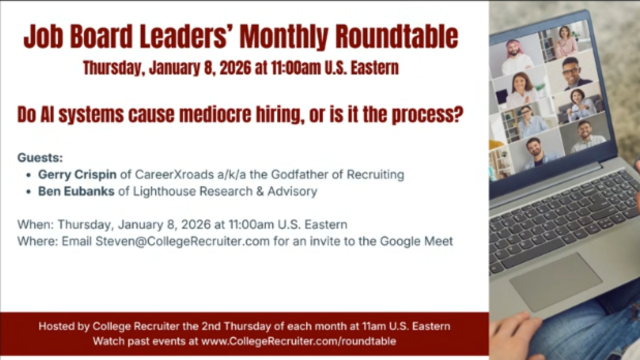
Last week Steven Rothberg of College Recruiter hosted a webinar with job boards and adjacent industries entitled “Do AI systems cause mediocre hiring, or is it the process?”. The discussion focused on a growing concern many of us are seeing firsthand: AI-powered hiring tools are making it harder, not easier, for employers to distinguish between highly qualified and poorly qualified candidates.
Joining Steven were two of the most respected voices in the space: Gerry Crispin of CareerXroads and Ben Eubanks of Lighthouse Research & Advisory. Both were tremendously generous with their time and insights as they unpacked recent academic research that is raising uncomfortable but necessary questions for our industry.
The discussion centered on a recent paper, “Making Talk Cheap: Generative AI and Labour Market Signalling,” (https://jesse-silbert.github.io/website/silbert_jmp.pdf ) by Anaïs Galdin (Dartmouth College) and Jesse Silbert (Princeton University).
The study examined the impact of Freelancer.com’s LLM-assisted proposal writing tool on hiring outcomes – and the findings were striking:
- Low performers were hired nearly 20% more often
- High performers were hired about 20% less often
Why? Because AI-generated proposals caused applications to look remarkably similar. When the written signal disappeared, employers defaulted to what remained easy to compare: price.
In other words, generative AI didn’t just improve applications – it flattened them.
Why This Matters for Job Boards
Before large language models became ubiquitous, hiring managers could infer candidate quality based on effort, specificity, and customisation. Stronger candidates typically wrote stronger applications.
Post-LLM, applications are longer, more polished, and far harder to differentiate. Everyone sounds good.
As Gerry and Ben discussed, when signal collapses:
- hiring decisions become noisier
- confidence in screening declines
- and selection can become effectively random
Application quality no longer reliably reflects candidate quality.
Easy Apply + AI = Noise at Scale
At the top of the funnel, job boards are unintentionally amplifying the problem.
Easy Apply features combined with:
- AI-generated CVs
- automated application tools
- mass-apply services
mean employers now receive hundreds, sometimes thousands, of applications per role.
Screening becomes overwhelming. Trust erodes. And job boards are increasingly blamed for “low-quality candidates,” even though the underlying issue is signal dilution, not talent scarcity.
Employers Are Routing Around Job Boards
When applications stop functioning as a useful signal, employers revert to what feels safer:
- referrals and alumni networks
- narrow school or background filters
- internal mobility and “silver medalist” hires
Ironically, these approaches are well-known to be poor predictors of performance. Yet they’re rising because, at scale, job boards no longer provide usable differentiation.
This is not a talent problem. It’s a signal problem.
One thing was clear from the webinar discussion – the future of job boards is not more applications -it’s better data.
That means:
- collecting richer, more authentic signals earlier in the funnel
- using AI to gather data, not infer quality
- rethinking success metrics like “applications per job”
- exploring new models such as cost per quality application (CPA+)
It also means helping employers understand that 1,000 applications is not a win if none of them are distinguishable.
Job boards now face a choice. They can remain high-volume distribution platforms and continue to lose employer trust, or they can evolve into marketplaces designed for signal, authenticity, and outcomes.